Every time a conventional toilet is flushed, it may use the same quantity of water regardless of whether a full flush is actually necessary. Multiply that by several family members using the toilet multiple times a day, and flushing can become a significant part of household water consumption. In Indian cities where apartments depend on overhead tanks, borewells, municipal supply or tanker water, unnecessary flushing can also mean faster tank depletion and higher water-management costs.
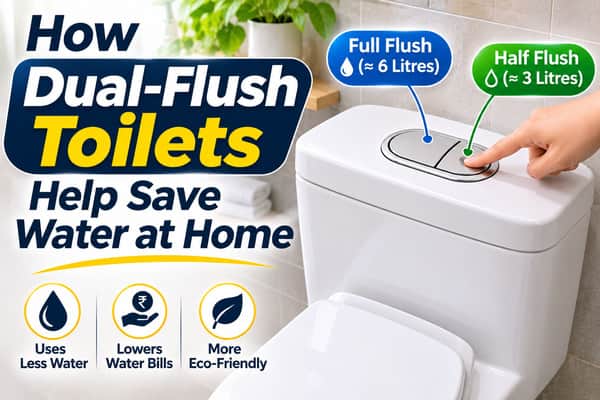
A dual-flush toilet addresses this problem with a simple idea: provide two flushing options. A smaller flush is intended mainly for liquid waste, while a larger flush provides more water for solid waste. Instead of releasing the maximum flush volume every time, users can select the amount more appropriate for the job.
The actual savings depend on the toilet’s flush volumes, household size, usage habits and flushing efficiency. But when correctly selected, installed and used, a dual-flush toilet can be a practical water-saving upgrade for Indian homes.
Dual-Flush Toilet: Quick Overview
| Feature | Dual-Flush Toilet |
|---|---|
| Flush Options | Two |
| Small Flush | Mainly for liquid waste |
| Full Flush | Mainly for solid waste |
| Main Benefit | Reduces unnecessary water use |
| Operation | Usually two buttons or divided control |
| Water Saving | Depends on flush volume and user habits |
| Suitable For | Homes, apartments and commercial bathrooms |
| Installation | Available in multiple toilet designs |
| Maintenance | Similar to regular toilets, but mechanism has additional components |
| Best Result | Efficient toilet + correct user behaviour |
What Is a Dual-Flush Toilet?
A dual-flush toilet provides two different flushing volumes.
The smaller flush uses less water and is generally intended for liquid waste. The full flush releases a larger volume to clear solid waste effectively.
The controls are commonly provided through:
- Two separate buttons
- One divided push button
- Dual-action flushing controls, depending on the model
The exact amount of water used varies between toilets, so buyers should check the manufacturer’s stated flush volumes rather than assuming every dual-flush model uses the same amount.
The important difference is choice.
A single-flush toilet normally provides one standard flush volume, whereas a dual-flush model allows users to avoid a full flush when it is unnecessary.
Why Toilet Flushing Matters for Household Water Consumption
Toilets are used repeatedly throughout the day.
Consider a household with four people. If each person flushes several times daily, the total number of flushes can quickly become significant.
Even saving a few litres on many of those flushes can add up over:
- One day
- One month
- One year
This is particularly relevant in Indian homes facing:
- Limited municipal supply hours
- Dependence on overhead storage tanks
- Borewell shortages
- Tanker-water costs
- Seasonal water scarcity
- Increasing focus on water conservation
Water-efficient toilets cannot solve a city’s water shortage, but they can reduce unnecessary consumption at the household level.
How the Half Flush Saves Water
The smaller flush is the central water-saving feature.
Liquid waste generally does not require the same flushing volume as solid waste. A dual-flush system allows the user to select a lower volume for these situations.
Imagine a household where most daily toilet uses require only the smaller flush.
Instead of releasing the full quantity every time, the toilet uses a reduced amount for those flushes.
Over hundreds or thousands of flushes, the difference can become meaningful.
However, savings depend on family members actually using the correct button. If everyone automatically selects the full flush, much of the potential advantage disappears.
Full Flush Still Provides Cleaning Power When Needed
Saving water should not mean sacrificing basic toilet performance.
The larger flush exists for situations where greater flushing force and water volume are required.
A properly designed dual-flush toilet should balance:
- Water quantity
- Water movement
- Bowl geometry
- Trapway design
- Outlet configuration
- Cistern performance
This is why judging a toilet only by litres per flush can be misleading.
A toilet that uses very little water but regularly requires a second flush may not deliver meaningful savings.
Flushing efficiency matters just as much as flush volume.
Dual-Flush Vs Single-Flush Toilets
The main difference is flexibility.
A single-flush toilet uses one flushing setting. Depending on its design, it may already be reasonably water-efficient, but the user cannot select a smaller flush for liquid waste.
A dual-flush model provides two options.
Dual-Flush Advantages
- Reduced water use for liquid waste
- Better control over each flush
- Suitable for water-conscious households
- Available in many modern toilet designs
- Can reduce unnecessary use of stored water
Possible Limitations
- More components in the flush mechanism
- Users must understand which button to use
- Poor-quality mechanisms can require maintenance
- Actual savings vary by model and behaviour
Therefore, dual flush should be evaluated as part of the toilet’s complete design rather than as a standalone marketing feature.
How Much Water Can a Dual-Flush Toilet Save?
There is no single figure applicable to every home.
The actual saving depends on:
- Old toilet’s flush volume
- New toilet’s half-flush volume
- New toilet’s full-flush volume
- Number of household members
- Number of daily flushes
- Ratio of small to full flushes
- Whether repeat flushing is required
- Leakage from the cistern
A home replacing an older high-volume toilet may see a more noticeable reduction than a home replacing an already efficient modern toilet.
You can estimate potential savings using:
Old daily flush consumption – New estimated daily flush consumption = Approximate daily water saving
Multiply this by 30 for an approximate monthly figure.
For a realistic calculation, use the actual litres-per-flush specifications of the toilets being compared.
Water Saving Can Reduce Pressure on Overhead Tanks
Many Indian homes and apartments store water in overhead tanks.
When household water use is high, tanks need to be refilled more frequently.
Reducing toilet-flushing consumption can help stored water last longer, particularly in larger families.
This can be useful during:
- Municipal supply interruptions
- Pump failures
- Summer shortages
- Low borewell yield
- Restricted apartment water schedules
For households buying tanker water, reducing avoidable consumption may also have an indirect financial benefit.
The exact saving will depend on local water arrangements and household usage.
A Leaking Toilet Can Cancel Out Your Savings
Installing a water-efficient toilet is of little value if the cistern continuously leaks into the bowl.
Some toilet leaks are obvious, while others are difficult to notice.
Warning signs include:
- Water continuously moving inside the bowl
- Cistern repeatedly refilling without use
- Hissing or trickling sounds
- Flush button sticking
- Water running after the flush cycle should have stopped
Possible causes include worn seals, incorrectly adjusted valves, debris or problems with the flushing mechanism.
Repair leaks promptly.
Water conservation depends on both efficient fixtures and proper maintenance.
User Behaviour Is Equally Important
Technology only works when people use it correctly.
Family members should know which control activates the smaller flush.
A simple rule is:
- Small flush: primarily liquid waste
- Full flush: solid waste or when greater flushing is required
Button designs are not identical across every manufacturer, so confirm the symbols or instructions for your specific toilet.
Children and guests may also press both buttons unnecessarily if the controls are unclear.
A good dual-flush toilet should have intuitive controls that make water-saving behaviour easy.
What to Check Before Buying a Dual-Flush Toilet
Do not purchase a toilet simply because the packaging says “water-saving.”
Check the complete product.
Flush Volume
Look for the stated water volume for both small and full flushes.
Flush Performance
Efficient water movement is important. Very low water consumption is not useful if repeat flushing becomes common.
Bowl and Trapway Design
These influence waste removal and resistance to blockage.
Water Pressure Requirements
Some flushing systems may have specific installation or pressure requirements. Confirm compatibility with your home’s water supply.
Cistern Components
Check the quality of:
- Inlet valve
- Outlet valve
- Flush buttons
- Seals
- Internal fittings
Spare-Part Availability
Flush mechanisms contain components that may eventually need servicing.
Choosing a product with easily available replacement parts can make long-term ownership much simpler.
Dual Flush Works With Different Toilet Designs
Dual-flush technology is not limited to one type of toilet.
Depending on the manufacturer and model, it can be found in:
- One-piece toilets
- Two-piece toilets
- Wall-hung toilets
- Floor-mounted toilets
- Concealed-cistern systems
- Rimless toilets
This gives homeowners flexibility when renovating a bathroom.
For example, someone choosing a wall-hung toilet can combine a concealed dual-flush cistern with a modern bathroom design.
The key is ensuring that the toilet bowl and flushing system are designed to work together.
Is It Worth Replacing an Existing Toilet?
Replacing a perfectly functional modern toilet solely to obtain dual flush may not always be financially or environmentally necessary.
First check:
- Current flush volume
- Toilet age
- Existing leaks
- Flush efficiency
- Water availability
- Renovation plans
If an old toilet consumes a large amount of water or already needs replacement, upgrading to an efficient dual-flush model can make practical sense.
If you are building a new bathroom or undertaking a major renovation, considering water-efficient fixtures from the beginning is even easier.
Simple Ways to Save More Water in the Bathroom
A dual-flush toilet works best as part of broader water-conscious habits.
Other practical steps include:
- Repair leaking taps promptly.
- Fix running toilet cisterns.
- Use appropriately efficient shower fittings.
- Turn taps off while brushing.
- Avoid unnecessary flushing.
- Maintain plumbing regularly.
- Monitor unusual increases in water consumption.
- Choose efficient fixtures when replacing old products.
Small reductions repeated every day can make a substantial difference over time.
FAQs
Q1. Does a half flush always use exactly half the water of a full flush?
A. No. “Half flush” is a common informal description of the lower-volume option, but it does not necessarily mean exactly 50% of the full-flush volume. Check the manufacturer’s litres-per-flush specifications.
Q2. Why does my dual-flush toilet need two flushes for solid waste?
A. Possible causes include incorrect cistern water level, a partially blocked trapway, scale or deposits, a faulty flush mechanism, or simply poor toilet design. If the problem occurs regularly, have the toilet inspected rather than routinely double-flushing.
Q3. Can I convert my existing toilet into a dual-flush toilet?
A. Some cisterns can accept compatible dual-flush conversion mechanisms, but not every toilet is suitable. The cistern design, dimensions, outlet valve and flushing requirements must match. A plumber or manufacturer can confirm compatibility.
Q4. Is a dual-flush toilet suitable for homes with low water pressure?
A. Many gravity-fed cistern toilets can work in Indian homes with overhead tanks, but requirements vary by model. Check the manufacturer’s recommended water pressure and filling requirements before purchase, especially for specialised flushing systems.