Walk into an Indian home with furniture that has been in the family for decades, and there is a good chance that at least one old cupboard, dining table, bed or chair is made from teak. Even after years of everyday use, well-made teak furniture can remain strong enough to be repaired, polished and used again. This long service life is one reason teak has earned such a strong reputation in Indian furniture making.
Teak wood is valued for a combination of strength, dimensional stability, natural oils, resistance to moisture and insects, attractive grain and long-term durability. These characteristics can make it suitable for everything from beds and dining tables to doors, cabinets and selected outdoor furniture.
However, simply seeing the word “teak” on a product does not guarantee superior furniture. Timber quality, seasoning, construction, joinery, finish and authenticity all matter. Genuine, properly processed teak can be an excellent furniture material, but buyers should understand what they are paying for before choosing it over alternatives.
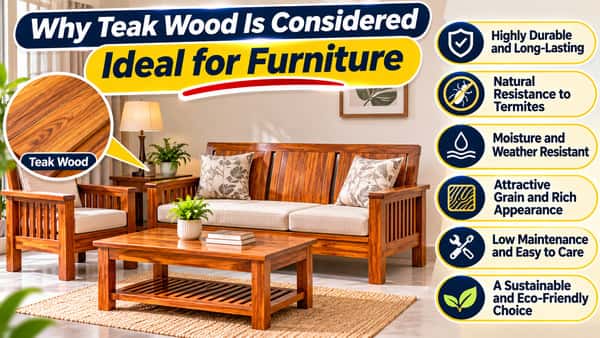
Teak Wood Furniture: Quick Overview
| Factor | Teak Wood |
|---|---|
| Durability | Excellent when properly seasoned and maintained |
| Strength | Suitable for heavy-use furniture |
| Moisture Resistance | Naturally good compared with many woods |
| Termite Resistance | Generally good due to natural properties |
| Appearance | Warm colour with attractive natural grain |
| Dimensional Stability | Generally good when correctly seasoned |
| Indoor Use | Excellent |
| Outdoor Use | Suitable with correct construction and maintenance |
| Maintenance | Moderate and depends on desired appearance |
| Repairability | Generally good |
| Price | Usually premium |
| Best For | Long-term, high-quality furniture |
What Makes Teak Different From Many Other Woods?
Teak is a hardwood widely valued for its natural properties.
One of its distinguishing characteristics is the presence of natural oils and extractives within the timber. These contribute to teak’s reputation for durability and its ability to perform well under conditions that can be challenging for many other woods.
Good-quality teak also combines several useful characteristics:
- Strong but workable timber
- Good resistance to normal moisture exposure
- Attractive grain
- Good dimensional stability
- Natural durability
- Long service life when properly used
Instead of being exceptional in only one area, teak offers a useful balance of properties, which helps explain its popularity for premium furniture.
Teak Furniture Can Last for Decades
Durability is perhaps the biggest reason families invest in teak furniture.
A well-constructed teak bed, dining table or cabinet can remain functional for many years when used and maintained appropriately.
This is especially valuable for furniture that experiences daily loads and movement, such as:
- Beds
- Dining tables
- Dining chairs
- Benches
- Cabinets
- Desks
- Doors and frames
Solid teak furniture can also often be repaired or refinished instead of discarded when the surface becomes old.
However, long life depends on more than wood species.
Poor joinery, inadequately seasoned timber or weak hardware can shorten the lifespan of even expensive teak furniture.
Natural Oils Improve Moisture Resistance
Indian homes can experience substantial changes in humidity.
During the monsoon, moisture levels may rise significantly. Coastal cities such as Mumbai, Chennai, Kochi and Goa can experience humid conditions for much of the year.
Wood naturally reacts to changes in environmental moisture.
Teak is appreciated because its natural properties can give it good resistance to moisture-related deterioration compared with many less durable woods.
This is one reason teak has historically been used in demanding applications.
But moisture-resistant does not mean waterproof.
Teak furniture should still be protected from:
- Standing water
- Continuous dampness
- Plumbing leaks
- Wet floors
- Poorly ventilated storage
- Prolonged uncontrolled exposure
Correct construction and maintenance remain essential.
Teak Offers Good Dimensional Stability
Natural wood expands and contracts as moisture conditions change.
If this movement is excessive—or if timber has not been seasoned correctly—furniture can develop:
- Warping
- Cracks
- Joint movement
- Misaligned shutters
- Uneven surfaces
Properly seasoned teak generally offers good dimensional stability, making it useful for precision furniture and joinery.
This can be particularly valuable for wardrobes, doors, tables and cabinets where alignment matters.
Still, no natural wood is completely immune to movement.
Furniture design must allow for normal timber expansion and contraction.
Teak Has Natural Resistance to Termites and Insects
Termites are a serious concern in many Indian homes.
Teak is known for relatively good natural resistance to termites and certain wood-damaging organisms, particularly when good-quality heartwood is used.
Its natural oils and chemical compounds contribute to this resistance.
This is an advantage over some less naturally durable timbers.
However, calling teak 100% termite-proof would be misleading.
Risk can still depend on:
- Quality and portion of timber used
- Sapwood versus heartwood
- Building infestation
- Moisture conditions
- Storage
- Furniture construction
If a home already has a termite infestation, professional building-level treatment may be necessary regardless of the furniture material.
Teak Has an Attractive Natural Appearance
Teak does not need elaborate decoration to look premium.
Its natural colour and grain can become a major design feature.
Depending on origin, age, cut and finish, teak can display warm golden-brown to deeper brown tones with attractive grain variation.
It works particularly well in:
- Traditional Indian interiors
- Contemporary homes
- Minimalist furniture
- Colonial-inspired designs
- Luxury interiors
- Rustic spaces
The surface can be finished in different ways depending on the desired appearance.
Some owners prefer a polished, rich finish, while others prefer a more natural matte appearance.
Because genuine timber varies naturally, colour and grain differences should not automatically be considered defects.
Teak Is Suitable for Heavy-Use Furniture
Furniture such as beds and dining chairs experiences repeated mechanical stress.
Joints are loaded whenever someone sits, moves or changes position.
Teak’s strength and durability make it particularly suitable for furniture where structural performance matters.
It is commonly chosen for:
- Bed frames
- Dining sets
- Large tables
- Chairs
- Benches
- Storage cabinets
But construction quality is equally important.
For example, a dining chair made from excellent teak can still become loose if the joints are poorly designed.
When buying furniture, inspect the joinery and workmanship rather than focusing only on the wood name.
Teak Can Be Refinished
One major advantage of solid teak furniture is its ability to age and be restored.
Over many years, furniture may develop:
- Scratches
- Dullness
- Small surface marks
- Worn finish
Depending on its condition, solid teak can often be cleaned, sanded carefully, repaired and refinished.
This can give an old piece a substantially refreshed appearance without replacing the entire item.
That makes teak attractive for people who view furniture as a long-term household asset rather than something that will be replaced every few years.
It can also explain why older teak furniture is often passed between generations.
Teak Can Work for Outdoor Furniture
Teak’s moisture resistance and natural durability also make it popular for selected outdoor applications.
It can be used for:
- Balcony chairs
- Garden benches
- Outdoor tables
- Patio furniture
However, outdoor exposure is much harsher than indoor use.
Sunlight, rain, dust and temperature changes will gradually alter the appearance of the wood.
Untreated outdoor teak can develop a weathered grey appearance over time. Some people appreciate this natural ageing, while others prefer maintaining the warmer original colour through appropriate care.
Outdoor furniture should still be designed with proper drainage, joints and suitable hardware.
Why Is Teak Furniture Expensive?
Good teak is generally a premium furniture material.
Several factors contribute to cost.
Quality Timber Is Valuable
Mature, properly processed timber is a valuable raw material.
Seasoning Takes Time and Skill
Furniture timber needs suitable moisture control before construction. Poor seasoning can create problems later.
Solid Furniture Uses Significant Material
A large bed or dining table may require substantial quantities of quality timber.
Skilled Joinery Matters
Premium solid-wood furniture often involves experienced carpentry and careful finishing.
Therefore, a very low price for supposedly “solid premium teak” should encourage closer inspection rather than immediate excitement.
Not Everything Sold as Teak Is the Same
This is one of the most important points for Indian furniture buyers.
Products may be described using terms such as:
- Solid teak
- Teak wood
- Teak finish
- Teak colour
- Teak veneer
These descriptions do not necessarily mean the same thing.
Teak finish may simply refer to colour or surface appearance.
Teak veneer generally means a thin layer of teak applied over another substrate.
Neither should automatically be presented as solid teak furniture.
Ask the seller to specify exactly which parts are solid teak and whether any engineered board, other timber or veneer is used.
How to Choose Good Teak Furniture
Before spending on premium teak furniture, inspect more than the polished surface.
Look for:
- Clear material specification
- Properly seasoned timber
- Strong joinery
- Smooth finishing
- Stable legs and frames
- Quality hinges and hardware
- Suitable timber thickness
- Reliable seller or manufacturer
- Written warranty where offered
Also inspect hidden areas such as the underside of tables, backs of furniture and internal sections.
If authenticity is particularly important, buy from a reputable manufacturer capable of clearly documenting the material being supplied.
When Is Teak Worth the Extra Cost?
Teak can make excellent financial sense when purchasing furniture you expect to use for a long time.
It can be particularly suitable for:
- Main bed
- Dining table
- High-use chairs
- Premium cabinets
- Long-term home furniture
- Selected outdoor furniture
For temporary furniture, rental accommodation or a room likely to be redesigned frequently, spending heavily on solid teak may not be necessary.
In those situations, quality plywood or other suitable engineered materials may provide better value.
The best material is not necessarily the most expensive one—it is the one appropriate for the furniture’s expected use.
FAQs
1. Is teak wood completely waterproof?
No. Teak has good natural moisture resistance, but it is not completely waterproof. Continuous dampness, standing water and poor storage can still cause problems. Indoor furniture should be protected from leaks and prolonged water exposure.
2. Does teak furniture need regular polishing?
Not necessarily. Maintenance depends on the existing finish and the appearance you want. Routine dusting and suitable cleaning may be enough for many pieces. Re-polishing or refinishing is generally done when the surface becomes worn rather than on an unnecessarily frequent schedule.
3. How can I tell solid teak from teak veneer?
Solid teak normally shows natural grain through the actual timber, including relevant exposed edges and surfaces. Veneer is a thin natural-wood layer over another material. Inspect edges and hidden areas and ask the seller for written material specifications rather than relying only on surface appearance.
4. Is teak better than plywood for furniture?
Neither is universally better. Solid teak is excellent for durable freestanding furniture, repairability and natural appearance. Quality plywood can be more practical and economical for large wardrobes, modular kitchens and extensive cabinetry. The right material depends on application, construction and budget.