In India, festivals are remembered as much through taste and aroma as through decorations, prayers and family gatherings. The smell of ghee-roasted flour before Diwali, modaks steaming during Ganesh Chaturthi, the first bite of gujiya at Holi or a pot of pongal slowly cooking during the harvest season can instantly bring back memories of home.
These foods are not simply festive treats. Many developed through a combination of religious customs, agricultural cycles, seasonal availability, regional ingredients and family traditions. Long before refrigeration and modern supermarkets, households prepared festival menus around what was locally available at a particular time of year. Temple offerings, royal kitchens, trade routes and community celebrations added further layers to India’s culinary traditions.
There is rarely one precise date when a festival food was “invented.” Most evolved over generations. Understanding their history therefore means understanding why certain ingredients, cooking techniques and symbolic meanings became attached to particular celebrations.
India’s Iconic Festival Foods at a Glance
| Festival | Iconic Food | Strong Association | Cultural Connection |
|---|---|---|---|
| Diwali | Laddoo & Other Mithai | Across India | Celebration, gifting and hospitality |
| Holi | Gujiya | North India | Seasonal festive sweet |
| Ganesh Chaturthi | Modak | Maharashtra & other regions | Offering associated with Lord Ganesha |
| Pongal | Sakkarai/Ven Pongal | Tamil Nadu | Harvest and thanksgiving |
| Makar Sankranti | Til-Gud Sweets | Maharashtra & other regions | Sesame and jaggery in winter |
| Onam | Onam Sadya | Kerala | Community feast and harvest tradition |
| Eid | Sheer Khurma | Many Indian Muslim households | Festive hospitality |
| Janmashtami | Makhan-Mishri | Many regions | Krishna tradition |
| Durga Puja | Bhog Khichuri | Bengal | Community offering and meal |
| Christmas | Cakes & Regional Sweets | Indian Christian communities | Celebration and local adaptation |
Diwali and the Long Tradition of Mithai
Few Indian festivals are as strongly associated with sweets as Diwali.
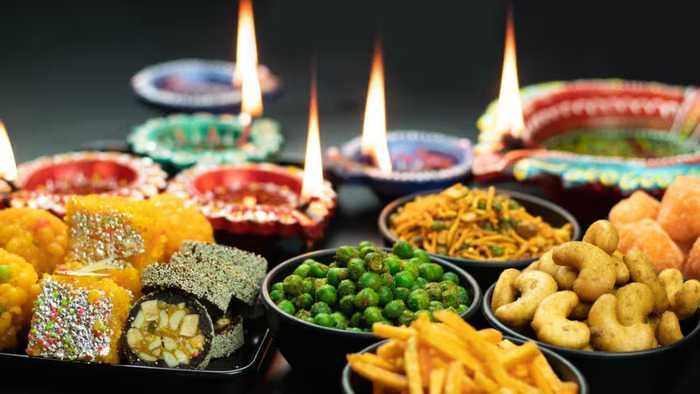
Today, boxes of kaju katli, laddoo, barfi, peda and other mithai move between homes, offices and businesses throughout the festive season. But the connection between celebrations and sweets is much older than modern packaged gift boxes.
Sweet foods have historically represented hospitality, prosperity and auspicious beginnings in many Indian traditions. Ingredients such as milk, ghee, grains and jaggery were transformed into special dishes for religious offerings and important occasions.
Sugar production also has a deep history in the Indian subcontinent, while regional dairy traditions contributed to an enormous variety of milk-based sweets.
Over time, Diwali became an occasion when households prepared foods that were richer and more elaborate than everyday meals.
Regional Diwali menus still vary considerably:
- Maharashtra is known for festive faral, including chakli, karanji and ladoo.
- North Indian homes commonly prepare or purchase laddoo, barfi and other mithai.
- Gujarat has its own combination of sweet and savoury festive snacks.
- Southern states maintain distinctive regional Deepavali preparations.
The modern Diwali sweet box is therefore only the newest form of a much older culture of festive sharing.
Why Gujiya Became Closely Associated With Holi
Holi means colours, gatherings and, across much of North India, gujiya.
The familiar sweet consists of a flour shell folded around a rich filling that commonly contains ingredients such as khoya, sugar, nuts or coconut before being fried.
Its exact origin is difficult to assign to a single historical moment. Filled pastries have existed in different forms across South Asia and beyond for centuries, and India’s trade and cultural exchanges helped cooking techniques travel and evolve.
What made gujiya particularly suited to a festival was its richness and ability to be prepared in batches for visiting family and friends.
Different regions developed related versions. Maharashtra’s karanji, for example, resembles gujiya in shape but may feature a coconut-based filling.
Holi households often prepare other special foods and drinks as well, but gujiya became one of the festival’s most recognisable culinary symbols.
Modak and Ganesh Chaturthi
Mention Ganesh Chaturthi in Maharashtra and modak immediately comes to mind.
Modak has a distinctive dumpling-like shape and is traditionally associated with Lord Ganesha. Religious traditions frequently describe modak as a favoured food of Ganesha, which explains its central place as an offering during the festival.
One particularly important version is ukadiche modak.
It typically uses:
- Rice-flour covering
- Coconut
- Jaggery
- Ghee
- Cardamom or other aromatics
The ingredients themselves reflect western India’s food landscape, where rice, coconut and jaggery have long-standing culinary roles.
The sweet is usually steamed rather than fried.
Modern bakeries now offer chocolate, dry-fruit and numerous flavoured modaks, but traditional steamed versions continue to carry particularly strong cultural significance.
This is a good example of how religious symbolism and regional agriculture combine to create a festival food tradition.
Pongal: When a Harvest Becomes a Dish
In Tamil Nadu, the word Pongal refers both to the harvest festival and to the famous rice-based preparation associated with it.
This connection could hardly be more direct.
Pongal celebrates the agricultural cycle and expresses gratitude for the harvest. Rice is therefore not merely an ingredient—it represents the crop at the heart of the celebration.
During festivities, newly harvested rice may be cooked with milk, and the overflowing of the pot carries associations with abundance and prosperity.
Two familiar preparations include:
- Sakkarai Pongal: a sweet version commonly prepared with rice, jaggery and other ingredients.
- Ven Pongal: a savoury rice-and-lentil preparation.
The symbolism comes from transforming the harvest itself into the celebratory meal.
Rather than importing a luxurious ingredient from somewhere else, Pongal celebrates what the land and farmers have produced.
Til-Gud and Makar Sankranti
Makar Sankranti is celebrated in different forms across India, and food traditions change from one region to another.
In Maharashtra, til-gul or til-gud, made using sesame and jaggery, is strongly associated with the festival.
This combination also makes seasonal sense.
Makar Sankranti occurs during winter, when energy-dense foods made with sesame, groundnuts and jaggery have traditionally fitted naturally into seasonal diets.
Sesame and jaggery appear in festival foods across several regions, though names and preparations differ.
Examples include:
- Til laddoo
- Til chikki
- Sesame-jaggery mixtures
- Regional sweets using peanuts or other winter ingredients
The tradition demonstrates how festival calendars and agricultural seasons often overlap.
Food was historically not chosen only for symbolic meaning. Seasonal availability mattered too.
Onam Sadya: A Festival Served on a Banana Leaf
Unlike festivals represented by one famous sweet, Onam in Kerala is associated with an entire feast—the Onam Sadya.
Traditionally served on a banana leaf, a sadya brings together multiple vegetarian preparations, potentially including rice, vegetable dishes, pickles, accompaniments and payasam.
The exact number and selection of dishes vary by household and occasion.
Its historical importance is closely linked to Kerala’s agricultural and community traditions. Onam is associated with harvest, prosperity and the legendary King Mahabali.
A sadya showcases ingredients central to Kerala’s food culture, including:
- Coconut
- Rice
- Banana
- Yam and other vegetables
- Lentils
- Spices
- Jaggery
The banana leaf itself reflects a traditional serving method well suited to the local environment.
What makes the Onam Sadya particularly significant is not one expensive ingredient but the variety and balance of dishes brought together for a communal celebration.
Sheer Khurma and Eid Celebrations
For many Muslim families in India, the aroma of sheer khurma is inseparable from Eid-ul-Fitr.
The name is associated with a rich preparation based on milk and vermicelli, commonly enhanced with dates and nuts.
Recipes vary considerably between households.
Typical ingredients can include:
- Milk
- Vermicelli
- Dates
- Almonds
- Pistachios
- Cashews
- Raisins
- Cardamom
Eid-ul-Fitr marks the end of Ramadan, making food, hospitality and shared meals especially meaningful.
Sheer khurma is commonly prepared for family members and guests, turning it into more than dessert. It becomes part of the hospitality surrounding the celebration.
Generations of Indian families have developed their own versions, illustrating how a broader Islamic culinary tradition has acquired distinctive regional and household expressions across South Asia.
Makhan-Mishri and Janmashtami
Janmashtami celebrates the birth of Lord Krishna, and its food traditions frequently reflect stories associated with Krishna’s childhood.
Krishna’s connection with butter and dairy products is deeply embedded in popular religious narratives.
This explains the importance of makhan-mishri, a simple combination of butter and sugar crystals, as an offering in many communities.
Other Janmashtami foods vary regionally and according to fasting traditions.
The significance of dairy also reflects India’s long pastoral history. Milk, curd, butter and ghee have occupied important places in both everyday diets and religious offerings.
Here, a relatively simple food becomes iconic primarily because of storytelling and religious symbolism, rather than elaborate preparation.
Bhog Khichuri During Durga Puja
Durga Puja in Bengal is famous not only for spectacular pandals but also for food.
Among the most meaningful preparations is bhog khichuri, served as part of the offering and community meal.
Khichuri commonly brings rice and lentils together, often accompanied during festive bhog by vegetable preparations, fried items, chutney and sweets.
Its importance demonstrates that iconic festival food does not always have to be expensive or complicated.
Community eating itself is central to the experience.
For many people, waiting for bhog at a Durga Puja pandal is as much a social memory as a culinary one.
How Trade Changed Indian Festival Foods
India’s festival cuisine has never been completely static.
Trade and migration introduced ingredients that eventually became so familiar that it is difficult to imagine Indian cooking without them.
Different historical exchanges influenced the availability and use of:
- Refined sugar
- Dry fruits
- New spices and aromatics
- Cooking techniques
- New World crops
- Bakery traditions
Royal courts, merchants, migrants and colonial encounters all contributed to culinary exchange.
Indian cooks rarely adopted new ingredients unchanged. They incorporated them into existing tastes, religious practices and regional cooking methods.
This is one reason festival foods can simultaneously feel ancient and constantly evolving.
Why Traditional Festival Foods Still Matter
Today, practically every major mithai can be ordered through a smartphone. Yet families continue making difficult recipes at home during festivals.
The reason is simple: festival foods preserve more than flavour.
They preserve:
- Family recipes
- Regional identity
- Religious practices
- Seasonal traditions
- Childhood memories
- Community relationships
A grandmother teaching a younger family member to shape gujiyas or modaks is passing down knowledge that cannot be captured by an ingredient list alone.
Recipes will continue to change—air-fried snacks, low-sugar mithai and fusion desserts are already common—but the emotional role of festival food remains remarkably strong.
FAQs
1. Why are sweets so common during Indian festivals?
A. Sweet foods have long been associated with auspicious occasions, hospitality, religious offerings and celebration in many Indian communities. Ingredients such as jaggery, sugar, milk, ghee and grains also developed strong ceremonial roles, although traditions differ greatly by region and religion.
2. Are all Indian festival foods ancient recipes?
A. No. Some have very old roots, while others evolved through trade, migration, royal cuisines, changing agricultural practices and the introduction of new ingredients. Even traditional dishes continue to change between generations.
3. Why does the same festival have different foods in different Indian states?
A. India’s climate, crops, religious customs and local food cultures vary enormously. Families historically cooked with ingredients readily available in their region, which is why one festival can have completely different menus in Maharashtra, Bengal, Kerala, Punjab or Tamil Nadu.
4. Are modern versions such as chocolate modak still traditional festival foods?
A. They are modern adaptations rather than traditional recipes, but culinary traditions constantly evolve. Chocolate or flavoured modaks can exist alongside traditional ukadiche modak without replacing the cultural importance of the original preparation.