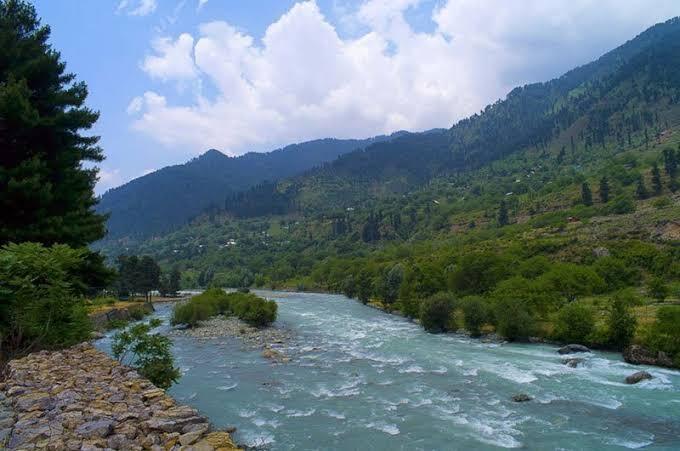
The Jhelum River is one of the most important rivers of the northwestern Indian subcontinent and a major river of the Indus River system. Flowing through the beautiful Kashmir Valley, the Jhelum has shaped settlements, agriculture and local life for centuries. Srinagar, one of the best-known cities in Jammu and Kashmir, developed along its banks, making the river closely connected with the geography and history of the region.
The Jhelum begins at the famous Verinag Spring in Anantnag district of Jammu and Kashmir. From there, it flows through the Kashmir Valley, passes through Srinagar and Wular Lake, and continues towards Pakistan-administered territory before eventually joining the Chenab River in Pakistan. Its total length is generally stated to be about 725 km, although figures can vary slightly depending on the method used to measure the river.
For Indian readers, the Jhelum is especially important for understanding the drainage system of Jammu and Kashmir. Its tributaries, lakes, wetlands and surrounding catchment form an interconnected water system that supports agriculture, hydropower, biodiversity and communities across the valley.
Jhelum River Overview
| Particular | Details |
|---|---|
| River Name | Jhelum River |
| Ancient Name | Vitasta |
| River System | Indus River System |
| Origin | Verinag Spring |
| Origin Location | Anantnag district, Jammu and Kashmir |
| Approximate Total Length | About 725 km |
| Indian Region | Jammu and Kashmir |
| Major City on Its Banks | Srinagar |
| Important Lake Connected to River | Wular Lake |
| Major Tributaries | Lidder, Sind, Vishav, Rambiara and Pohru |
| Final Confluence | Chenab River in Pakistan |
| River Type | Transboundary river |
Where Does the Jhelum River Originate?
- The Jhelum River originates from Verinag Spring, situated in the Anantnag district of Jammu and Kashmir. Verinag lies near the foothills of the Pir Panjal range and is known for its clear spring water and scenic surroundings.
- The spring is traditionally regarded as the source of the Jhelum. Water emerging from Verinag develops into a stream that gradually becomes the main river as it travels through the Kashmir Valley and receives water from other streams and tributaries.
- The river was known as Vitasta in ancient Indian literature and continues to hold historical and cultural significance.
Key facts about the origin of the Jhelum River:
- It originates at Verinag Spring.
- The source is located in Anantnag district.
- Verinag lies near the Pir Panjal range.
- The river is part of the larger Indus drainage system.
- Its ancient name is Vitasta.
- It is one of the major rivers flowing through the Kashmir Valley.
What Is the Length of the Jhelum River?
- The total length of the Jhelum River is approximately 725 kilometres.
- The river begins in Jammu and Kashmir and continues beyond the Line of Control before flowing through Pakistan and eventually joining the Chenab River.
- Different references may provide slightly different figures for the river’s total length because measurements can vary according to the exact source, river bends and mapping methods used.
- Despite being shorter than the Indus, the Jhelum is one of the most significant tributaries in the wider Indus river system.
Which Indian State or Union Territory Does the Jhelum River Flow Through?
Within India, the Jhelum River flows through the Union Territory of Jammu and Kashmir.It is particularly associated with the Kashmir Valley, where the river passes through several important areas.
1. Anantnag
The river begins in Anantnag district at Verinag. Several streams and water channels of south Kashmir eventually contribute to the Jhelum system.
2. Srinagar
- The Jhelum passes directly through Srinagar, making it one of the most recognisable geographical features of the city.
- Historically, settlements, markets and important structures developed close to the river. Several bridges cross the Jhelum within Srinagar and connect different parts of the city.
3. Baramulla
- After moving through Srinagar and the Wular Lake system, the Jhelum continues towards Baramulla.
- From here, it flows through a narrower valley before moving further west.
- Therefore, if the question is specifically about Indian states through which the Jhelum flows, the correct present-day answer is that its Indian course lies within the Union Territory of Jammu and Kashmir.
Course of the Jhelum River
The Jhelum follows a fascinating course through mountainous terrain, valleys, wetlands and populated areas.
1. From Verinag to the Kashmir Valley
- The river starts at Verinag and flows generally north-west through the Kashmir Valley. In its upper reaches, numerous smaller streams contribute water to the river.
- The surrounding mountains receive rain and snowfall, and snowmelt becomes an important source of water for the river system.
2. Through Srinagar
- The Jhelum then passes through Srinagar. Here, the river has historically been closely linked with transportation, settlements, trade and urban development.
- Its presence also means that water-level management and flood protection are particularly important for the city.
3. Connection with Wular Lake
- Further downstream, the Jhelum is closely connected with Wular Lake, one of India’s largest freshwater lakes.
- Wular acts as an important natural water-storage and flood-buffering feature within the Jhelum basin. The lake and its associated wetlands are also valuable habitats for birds and aquatic life.
4. Towards Baramulla and Beyond
- After the Wular region, the Jhelum flows towards Baramulla and then through mountainous terrain towards Uri.
- It subsequently continues westward beyond the Indian-administered region, eventually flowing into Pakistan and joining the Chenab River.
- The Chenab itself later becomes part of the larger Indus drainage network.
Major Tributaries of the Jhelum River
A network of tributaries and mountain streams feeds the Jhelum. Snowmelt, springs and seasonal rainfall contribute to these waterways.
Some of its important tributaries in the Kashmir region include:
1. Lidder River
- The Lidder River is an important tributary of the Jhelum and is closely associated with the Pahalgam region.
- It is fed significantly by snow and glacier melt from the surrounding mountains and eventually joins the Jhelum near the Anantnag region.
2. Sind River
- The Sind River, often called the Sindh River in Kashmir, is another important tributary of the Jhelum.
- It drains areas around the Sind Valley and receives water from snow-covered mountain regions. It contributes to the Jhelum system north of Srinagar.
3. Vishav River
- The Vishav River drains parts of south Kashmir and ultimately contributes its water to the Jhelum system.
- Its catchment includes mountainous areas where rainfall and snowmelt influence seasonal flows.
4. Rambiara River
- The Rambiara River is another tributary associated with south Kashmir. It drains parts of the Pir Panjal region and contributes to the broader Jhelum drainage network.
5. Pohru River
- The Pohru River is an important tributary in north Kashmir. It drains parts of the Kupwara region before joining the Jhelum.
Important tributaries of the Jhelum include:
- Lidder River
- Sind River
- Vishav River
- Rambiara River
- Pohru River
Together with numerous smaller streams, these rivers form an extensive drainage network across the Kashmir Valley.
Jhelum River and Wular Lake
- One of the most interesting features of the Jhelum River is its relationship with Wular Lake.
- Located in north Kashmir, Wular Lake forms an important part of the Jhelum basin. The river system is closely connected with the lake, which helps temporarily store excess water.
This makes Wular important for:
- Flood moderation
- Water storage
- Fisheries
- Wetland biodiversity
- Livelihoods of local communities
- Habitat for migratory and resident birds
Protecting the lake and its wetlands is therefore closely connected with the health and water-management capacity of the wider Jhelum River system.
Importance of the Jhelum River
The Jhelum plays an important role in the environmental and economic life of the Kashmir Valley.
1.Agriculture and Irrigation
Water from the Jhelum and its tributaries supports agricultural activities across the valley. Irrigation channels distribute water to cultivated areas where local crops are grown.
2.Hydroelectric Power
The steep terrain through which parts of the Jhelum system flow creates opportunities for hydroelectric power generation.
Important hydropower projects are associated with the river, particularly in its downstream mountainous stretches.
3.Water Supply
The river and its connected water bodies form an important component of the region’s freshwater resources.
4. Biodiversity
The Jhelum basin includes:
- Rivers and streams
- Freshwater lakes
- Wetlands
- Mountain ecosystems
- Floodplains
- Aquatic habitats
These environments support fish, birds, plants and numerous other species.
5. Historical Importance
The river has influenced settlement patterns in Kashmir for centuries.
Srinagar’s historical development is closely linked to the Jhelum, with old bridges and neighbourhoods forming part of the city’s riverfront identity.
Why Is the Jhelum River Important to the Indus River System?
The Jhelum is one of the major rivers of the Indus basin.
After leaving the Kashmir region, it eventually joins the Chenab River in Pakistan. The waters of the Chenab later contribute to the larger Indus system.
The basic connection can be understood as: Jhelum → Chenab → Panjnad → Indus → Arabian Sea
The Jhelum therefore forms an important part of the interconnected river network draining the northwestern Indian subcontinent.
Interesting Facts About the Jhelum River
Some useful facts to remember include:
- The Jhelum originates from Verinag Spring in Jammu and Kashmir.
- Its ancient name is Vitasta.
- The river flows through Srinagar.
- Its approximate total length is 725 km.
- It is part of the Indus River system.
- The Jhelum is closely connected with Wular Lake.
- It ultimately joins the Chenab River in Pakistan.
- The river is important for agriculture, hydropower, water resources and biodiversity.
FAQs About the Jhelum River
1. Where does the Jhelum River start and end?
The Jhelum River originates from Verinag Spring in Anantnag district, Jammu and Kashmir. It flows through the Kashmir Valley and continues into Pakistan, where it eventually joins the Chenab River.
2. What is the total length of the Jhelum River?
The Jhelum River is approximately 725 km long. The exact figure may vary slightly between geographical references depending on the method used for measuring its course.
3. Does the Jhelum River flow through Srinagar?
Yes. The Jhelum flows directly through Srinagar and is one of the city’s most important geographical features. Several historic bridges and old neighbourhoods of Srinagar are situated along its banks.
4. Is the Jhelum a tributary of the Ganga or Indus?
The Jhelum belongs to the Indus River system, not the Ganga system. It joins the Chenab River, whose waters eventually become part of the wider Indus drainage network.