Imagine travelling above 15,000 feet, where trees disappear, oxygen becomes noticeably thinner, snow remains on the mountains even in warmer months, and suddenly a brilliant blue lake appears between barren Himalayan peaks. India’s highest lakes are found in exactly these extreme landscapes, particularly in Sikkim, Ladakh and Himachal Pradesh.
For Indian travellers and general-knowledge readers, ranking the country’s highest lakes is not as straightforward as it sounds. India has numerous small, unnamed or little-documented glacial lakes at extreme elevations, while published altitudes for famous lakes can differ between government surveys and tourism records. Therefore, this list focuses on five of India’s best-known and documented high-altitude lakes, rather than claiming to rank every tiny glacial water body in the Himalayas.
Among the most famous are Gurudongmar and Tso Lhamo in Sikkim, followed by spectacular Himalayan lakes such as Suraj Tal in Himachal Pradesh and high-altitude lakes of Ladakh.
Top 5 Highest Lakes in India: Overview
| Rank | Lake | State/UT | Approx. Altitude | Famous For |
|---|---|---|---|---|
| 1 | Gurudongmar Lake | Sikkim | ~5,430 m (17,800 ft)* | Sacred Himalayan lake |
| 2 | Tso Lhamo Lake | Sikkim | ~5,100 m (16,730 ft) | Remote lake near Tibetan plateau |
| 3 | Suraj Tal | Himachal Pradesh | ~4,870–4,950 m | Source region of Bhaga River |
| 4 | Tso Moriri | Ladakh | ~4,522 m (14,836 ft) | Ramsar wetland and wildlife |
| 5 | Pangong Tso | Ladakh | ~4,225 m (13,860 ft) | Famous blue transboundary lake |
*Government sources report different measured elevations for Gurudongmar. Tourism and district authorities commonly quote approximately 5,430 m, while satellite-based wetland documentation has reported a lower measured elevation. This is one reason high-altitude lake rankings should be treated as approximate.
1. Gurudongmar Lake – Sikkim
Gurudongmar Lake in North Sikkim is one of India’s most famous high-altitude lakes.
The Mangan district administration places it at approximately 5,430 metres (17,800 feet) above sea level, making it one of the highest well-known lakes accessible by road in India.
Located close to the international border, Gurudongmar is surrounded by a dramatic landscape of snow-covered mountains and largely barren high-altitude terrain.
The lake also has deep religious importance and is regarded as sacred by local communities and followers of multiple faith traditions.
For travellers, however, the altitude is a serious consideration.
At 17,000-plus feet, oxygen availability is significantly lower than at sea level. Visitors can experience headache, nausea, dizziness and breathlessness associated with high altitude.
Gurudongmar should therefore never be treated like an ordinary sightseeing stop. Acclimatisation and current local travel rules are important, and access can also be affected by weather, road conditions and government restrictions.
2. Tso Lhamo Lake – Sikkim
A few kilometres from the Gurudongmar region lies another extraordinary water body: Tso Lhamo Lake, sometimes incorrectly referred to as Cholamu Lake.
The Government of Sikkim places Tso Lhamo at an elevation of approximately 5,100 metres.
Its name has a beautiful meaning. “Tsho” refers to lake, while “Lhamo” means goddess, giving it the sense of the “Goddess Lake.”
Tso Lhamo lies in the remote high-altitude landscape of North Sikkim near Donkhyala Pass and the Tibetan plateau.
Unlike more mainstream destinations such as Tsomgo Lake, this is not a lake that tourists can simply add casually to an ordinary Sikkim itinerary.
Its location is close to a sensitive international border, and access can be highly restricted.
The surrounding region is also associated with the upper catchment of the Teesta River system, giving these high-altitude lakes importance beyond tourism.
For geography students, Tso Lhamo is particularly worth remembering because it is among India’s highest named lakes.
3. Suraj Tal – Himachal Pradesh
Suraj Tal, also known as Surya Tal or Tso Kamtsi, is one of Himachal Pradesh’s most spectacular high-altitude lakes.
It lies in the Lahaul region near Baralacha La, on the famous Manali–Leh route.
A recent Himachal Pradesh government regional planning document places the lake at approximately 4,870 metres above mean sea level, while some tourism references give elevations closer to 4,950 metres.
The name “Suraj Tal” means Lake of the Sun God.
The lake receives water from snow and glaciers in the surrounding mountains and forms part of the headwaters associated with the Bhaga River. The Bhaga eventually joins the Chandra at Tandi to form the Chandrabhaga, which later becomes the Chenab.
One of Suraj Tal’s advantages for travellers is its location near the highway. Unlike many Himalayan lakes that demand lengthy treks, Suraj Tal can be seen relatively close to the Manali–Leh road when the route is open.
Winter snow makes the region inaccessible for a substantial part of the year.
4. Tso Moriri – Ladakh
Tso Moriri lies in the spectacular Changthang region of Ladakh at an elevation of approximately 4,522 metres.
Although lower than Gurudongmar, Tso Lhamo and Suraj Tal, it is still considerably higher than most famous lakes around the world.
Tso Moriri is roughly 19 kilometres long and is surrounded by barren mountains, high-altitude wetlands and vast open landscapes.
Its importance extends beyond scenery.
The Tso Moriri wetland is recognised as a Ramsar Site, highlighting its international ecological significance. The region provides valuable habitat for high-altitude birds and other wildlife.
Korzok village, situated near the western shore, is the principal settlement associated with the lake.
For tourists, Tso Moriri generally feels quieter and more remote than Pangong Tso. The journey requires careful planning because of long distances, limited facilities and high altitude.
Travellers should acclimatise in Ladakh before attempting an overnight stay in the region.
5. Pangong Tso – Ladakh
Pangong Tso is easily the most recognisable lake on this list.
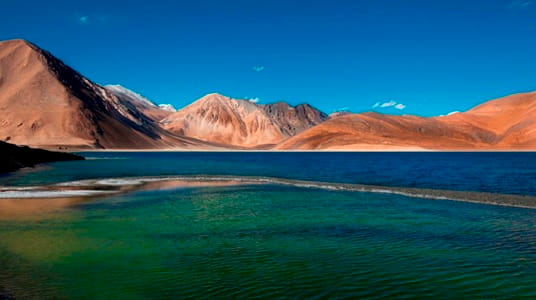
Located at roughly 4,225 metres (13,860 feet) above sea level, it stretches across the India-China border. Only part of this extraordinarily long lake lies within Indian-administered Ladakh.
Pangong became nationally famous through Indian cinema, but its natural setting is far more impressive than photographs suggest.
The lake appears to change colour depending on sunlight, clouds and viewing angle—from deep blue and turquoise to greyish shades.
Pangong is an endorheic lake, meaning it has no natural outlet to the ocean. Its water is saline, despite its location high in the mountains.
Winter conditions are severe enough for the lake to freeze.
Visitors normally travel to Pangong after spending time acclimatising around Leh. Even though it ranks below the first three lakes here, 4,225 metres is still a serious altitude.
Why Do Different Sources Give Different Lake Altitudes?
This is an important issue when researching India’s highest lakes.
For example, the Mangan district administration gives Gurudongmar’s altitude as 5,430 metres, while the National Wetland Atlas prepared using satellite-based documentation reports approximately 5,148 metres.
Suraj Tal similarly appears at roughly 4,800, 4,870, 4,883 or 4,950 metres depending on the source.
These differences can arise from measurement methods, GPS readings, mapping datasets and the exact shoreline or reference point being measured.
This is why extremely precise rankings should be approached cautiously.
It is safer to say that Gurudongmar and Tso Lhamo are among India’s highest famous named lakes, rather than claiming that no tiny or unnamed Himalayan glacial lake exists at a higher elevation.
What Makes High-Altitude Lakes Different?
Conditions above 4,000 metres are extreme.
Winters are long, temperatures fall dramatically, and many lakes freeze for months. Vegetation becomes sparse, while the surrounding ecosystems support species adapted specifically to cold, low-oxygen environments.
These lakes are often supplied by snowmelt, glaciers and high-altitude streams, making them sensitive to changes in temperature and precipitation.
They can also hold enormous cultural significance.
Gurudongmar and Tso Lhamo are sacred landscapes, while Suraj Tal’s name connects it with the Sun God.
For travellers, respecting the environment is particularly important. Plastic waste and careless tourism can remain in these cold, fragile ecosystems for long periods.
Visiting India’s Highest Lakes Safely
Do not judge a high-altitude lake trip only by road distance.
A person can feel perfectly comfortable at 2,000 metres and become unwell after rapidly travelling above 4,000 metres.
Acclimatise gradually, stay hydrated, avoid excessive physical exertion immediately after reaching high altitude and pay attention to symptoms such as persistent headache, nausea, confusion or unusual breathlessness.
Access rules also change.
Several high-altitude lakes lie near sensitive border regions where permits, checkpoints and travel restrictions may apply. Weather can close roads unexpectedly.
Before travelling, check the latest official local administration and tourism instructions rather than relying on an old itinerary or social-media video.
FAQs
1. Which is the highest lake in India?
Gurudongmar Lake in Sikkim is commonly described by government tourism and district sources as one of India’s highest lakes, at approximately 5,430 metres. However, altitude measurements vary between official datasets.
2. Is Tso Lhamo the same as Cholamu Lake?
Tso Lhamo is frequently referred to as Cholamu or Chho Lhamo in popular sources. The Government of Sikkim states that the name is often mispronounced as “Cholamu” and records Tso Lhamo at approximately 5,100 metres.
3. Which is the highest lake in Himachal Pradesh?
Suraj Tal in Lahaul and Spiti is among Himachal Pradesh’s highest prominent lakes, situated at roughly 4,870–4,950 metres near Baralacha La.
4. Can tourists visit all of India’s highest lakes?
No. Some are in restricted border areas, and access may depend on nationality, permits, road conditions, security restrictions and weather. Travellers should always check current official rules before planning a journey.