If you’ve ever planned a Srisailam temple trip and wondered what else is worth seeing besides the Jyotirlinga darshan, the answer is usually right down the road — literally. Srisailam Dam sits just a few kilometres from the temple, and it’s one of the most genuinely impressive pieces of engineering in South India, holding back the mighty Krishna River in a gorge deep within the Nallamala Hills. Whether you’re combining a spiritual visit with some sightseeing or simply curious about a dam that powers a significant chunk of the region, here’s everything worth knowing.
Quick Overview
| Detail | Information |
| River | Krishna River |
| Location | Nallamala Hills, on the border of Kurnool (Andhra Pradesh) and Mahabubnagar (Telangana) |
| Distance from Srisailam Temple | Around 13–15 km |
| Distance from Hyderabad | About 215–225 km |
| Nearest Railway Station | Markapur Road, roughly 85 km away |
| Nearest Airport | Rajiv Gandhi International Airport, Hyderabad |
| Dam Type | Concrete gravity dam |
| Construction Started | 1960 |
| Completed | 1981 (Phase 1); expanded to multipurpose project by 1987 |
| Dam Height | Around 145 metres (885 feet) |
| Dam Length | About 512 metres |
| Crest Gates | 12 radial gates |
| Live Storage Capacity | Around 274 TMC |
| Power Generation | 770 MW (post-1987 expansion) |
| Irrigation Coverage | About 200,000 acres across Kurnool and Cuddapah districts |
| Visiting Hours | Generally 6:00 AM to 7:30 PM |
| Best Time to Visit | November to March; August–September for full spillway views |
Where Srisailam Dam Is Located
Srisailam Dam sits deep within the Nallamala Hills, right at the point where Kurnool district in Andhra Pradesh meets Mahabubnagar district in Telangana, with the Krishna River flowing between them. It’s roughly 13 to 15 kilometres from Srisailam town, making it an easy add-on for anyone already visiting the Mallikarjuna Temple.
Getting here typically means driving the scenic but winding Hyderabad-Srisailam road, a route that passes directly through forest territory belonging to the Nagarjunasagar-Srisailam Tiger Reserve. This road has a strict closure window overnight, generally shutting from 9:00 PM to 6:00 AM, so travellers need to plan their journey to avoid getting stuck at a forest check-post after dark.
The River Behind This Massive Reservoir
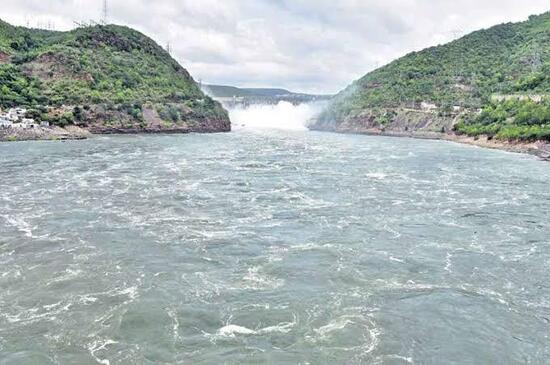
Srisailam Dam is built across the Krishna River, one of South India’s most significant waterways, cutting through a deep gorge in the Nallamala Hills roughly 300 metres above sea level. This particular stretch of the Krishna made an ideal dam site precisely because of its narrow valley formation, allowing engineers to create an enormous reservoir with a comparatively compact dam structure.
The reservoir this creates supplies irrigation water to roughly 200,000 acres of farmland across the drought-prone Rayalaseema region, spanning Kurnool and Cuddapah districts, making it a genuine lifeline for agriculture in an area that historically struggled with water scarcity.
A History Spanning Two Decades of Construction
Work on Srisailam Dam began in 1960, originally conceived purely as a power generation project. It took over two decades to complete, finally opening in 1981, a scale of construction that reflects both the technical complexity and the sheer size of the undertaking. Building this dam required flooding around 102 villages, a significant human cost that came with creating one of India’s largest reservoirs.
By 1987, a second construction phase transformed Srisailam from a purely power-focused project into a full multipurpose dam, adding an additional 770 MW of generation capacity and firmly establishing it as one of the largest hydroelectric projects in the country. Today, six reversible 150 MW Francis pump turbines operate on the left bank of the river, while seven 110 MW Francis turbine generators run on the right bank, making this a genuinely massive power-generating complex.
What Makes a Visit to Srisailam Dam Worthwhile
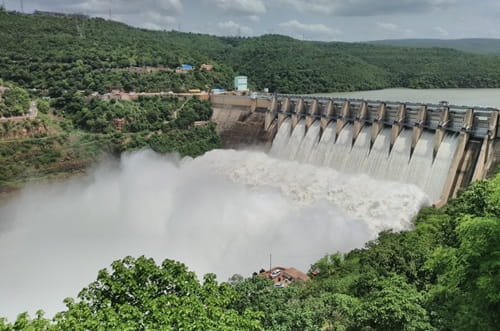
The dam’s sheer scale is the main draw, particularly when you consider it sits nestled within the Nallamala Hills, surrounded by the Srisailam Tiger Reserve’s dense forest cover. On a calm day, the view of the Krishna River’s still waters stretching out is genuinely peaceful, but the real spectacle happens when the crest gates open, usually during peak monsoon, sending a massive, powerful stream of water gushing out in a sight that visitors consistently describe as unforgettable.
Viewpoints exist on both sides of the dam, giving you different angles to appreciate the structure and the surrounding reservoir. If you’re travelling with a guided tour, APSRTC operates a roughly 2.5-hour bus circuit covering the dam along with nearby attractions like Phaladhara, Panchadhara, and Hatakeswaram, making it an efficient way to see several sights without arranging your own transport.
Timings and Practical Access Details
The dam area is generally accessible between 6:00 AM and 7:30 PM. However, the more important timing detail to remember is the Hyderabad-Srisailam forest road closure, which shuts to all vehicle traffic overnight between 9:00 PM and 6:00 AM as part of Tiger Reserve protection measures. Missing this window means being stranded at a checkpoint, so building your travel schedule around this restriction is genuinely essential rather than optional.
Facilities directly at the dam remain fairly basic, with several visitor reviews noting a lack of proper toilets or dedicated parking areas near the viewpoints. It’s sensible to carry water, snacks, and use facilities in Srisailam town before heading to the dam itself.
Best Time to Visit
November through March offers the most comfortable weather for a relaxed visit, with cooler temperatures making the drive and any walking around viewpoints far more pleasant. That said, if witnessing the dam’s crest gates in full flow is your priority, August and September, coinciding with peak monsoon rainfall upstream, tend to offer the best chance of seeing water gushing out in full force. Visitors travelling in the drier winter months, particularly January, have reported the gates being closed with no water flow, so it’s worth setting expectations accordingly if you’re visiting outside monsoon season.
Frequently Asked Questions
Q1. Can I combine a Srisailam Dam visit with the temple darshan in one trip?
A. Yes, easily. The dam is only about 13 to 15 kilometres from the Srisailam Temple, making it a natural add-on either before or after your darshan, provided you plan your timing around the forest road’s overnight closure.
Q2. Why does the Hyderabad-Srisailam road close at night?
A. The route passes through the Nagarjunasagar-Srisailam Tiger Reserve, and the Forest Department restricts nighttime vehicle movement to protect wildlife and reduce accident risk in this sensitive forest corridor.
Q3. What’s the best month to see the dam’s gates actually open?
A. August and September typically offer the best chance, since this coincides with peak monsoon inflow into the Krishna River. Visiting during drier winter months often means seeing the dam with its gates closed and minimal water flow.
Q4. Are there proper facilities like restrooms available at the dam viewpoints?
A. Not extensively. Several visitors have noted limited facilities directly at the dam site, so it’s advisable to use restrooms and stock up on water and snacks in Srisailam town before heading out to the viewpoints.