A mutual fund investor may have two very different goals. The first could be building a retirement corpus over the next 20 years, while the second could be keeping money relatively stable for a goal only a couple of years away. Using the same type of mutual fund for both goals may expose the investor to either unnecessary risk or insufficient growth.
This is where understanding equity mutual funds and debt mutual funds becomes important. Equity funds invest predominantly in shares of companies and are generally used for long-term growth. Debt funds primarily invest in fixed-income instruments such as government securities, corporate bonds and money-market instruments, with risk and return characteristics that differ significantly from equities.
Neither category is automatically better. Equity funds offer higher long-term growth potential but can experience substantial market fluctuations. Debt funds generally have lower volatility than equity funds, but they are not risk-free and their returns are not fixed like a traditional bank deposit.
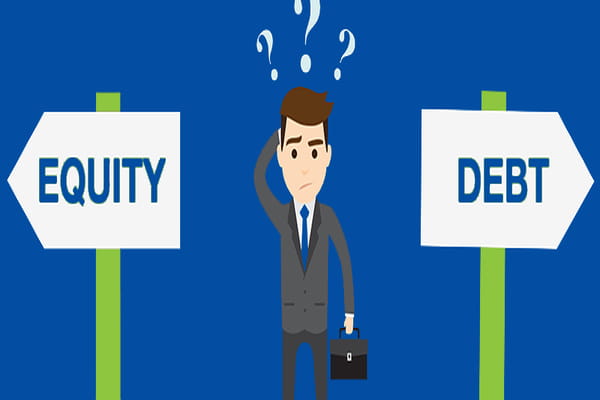
The right choice depends on your financial goal, investment horizon, risk capacity, liquidity needs and overall asset allocation.
Equity Mutual Fund Vs Debt Mutual Fund: Quick Comparison
| Factor | Equity Mutual Fund | Debt Mutual Fund |
|---|---|---|
| Primary Investment | Company shares | Fixed-income securities |
| Main Objective | Long-term capital growth | Income, stability and capital management |
| Risk Level | Generally higher | Generally lower than equity, but varies |
| Return Potential | Higher over long periods, not guaranteed | Usually lower than equity growth potential |
| Volatility | High | Usually lower |
| Suitable Horizon | Generally longer term | Depends on debt fund category |
| Market Risk | Significant | Present but different in nature |
| Credit Risk | Indirect through companies | Can be important in some debt funds |
| Interest-Rate Risk | Less direct | Important |
| Returns | Market-linked | Market-linked |
| Best For | Long-term growth-oriented goals | Shorter-duration or lower-volatility allocation, depending on fund |
What Is an Equity Mutual Fund?
An equity mutual fund invests predominantly in shares of companies according to the scheme’s stated investment mandate.
When you invest in an equity fund, you indirectly own exposure to a portfolio of businesses.
If those companies grow their profits and market values over time, the fund’s Net Asset Value (NAV) can potentially increase.
Equity funds can invest in different segments of the market, leading to categories such as:
- Large-cap funds
- Mid-cap funds
- Small-cap funds
- Flexi-cap funds
- Multi-cap funds
- Sectoral or thematic funds
- Index funds
- ELSS funds
These categories can carry very different levels of risk.
For example, a diversified large-cap-oriented portfolio and a concentrated sectoral fund should not be treated as having identical risk simply because both invest in equity.
What Is a Debt Mutual Fund?
A debt mutual fund primarily invests in fixed-income and money-market securities.
These may include:
- Government securities
- Treasury bills
- Corporate bonds
- Commercial paper
- Certificates of deposit
- Other eligible debt and money-market instruments
Instead of participating primarily in company ownership, debt funds generally earn through interest income and changes in the market value of the securities they hold.
There are several types of debt funds designed for different maturity profiles and strategies.
This is important because “debt fund” does not mean one uniform level of safety.
A liquid fund and a long-duration bond fund can behave quite differently when interest rates change.
Equity Funds Carry Greater Market Volatility
The stock market moves every day based on economic conditions, corporate earnings, interest rates, investor sentiment, global events and numerous other factors.
Equity mutual funds therefore experience regular price fluctuations.
Suppose you invest ₹5 lakh in an equity fund.
During a significant market correction, the value could fall substantially below your original investment.
This can be uncomfortable, but short-term volatility is part of equity investing.
Equity funds are therefore generally more appropriate when investors have enough time and financial capacity to tolerate periods of poor market performance.
Money required urgently should not depend heavily on favourable equity-market conditions.
Debt Funds Are Less Volatile, Not Risk-Free
One of the biggest misconceptions among investors is that debt mutual funds cannot lose money.
They can.
Debt funds face risks such as:
Interest-Rate Risk
Bond prices and interest rates generally move in opposite directions. When market interest rates rise, the value of existing bonds can decline.
Funds holding longer-duration securities can be more sensitive to interest-rate movements.
Credit Risk
If an issuer experiences financial difficulty or its perceived ability to repay deteriorates, the value of its debt securities may fall.
Liquidity Risk
Certain securities may become difficult to sell quickly at a reasonable price during stressed market conditions.
Therefore, debt funds should not be treated as guaranteed-return investments.
Return Potential Is Different
Equity funds generally offer greater long-term growth potential because investors participate in the growth of businesses.
However, higher potential return comes with higher uncertainty.
Debt fund returns are generally driven by:
- Interest earned on securities
- Changes in bond prices
- Portfolio maturity
- Credit quality
- Interest-rate movements
- Fund expenses
Debt returns can be positive or negative over particular periods depending on market conditions and the fund’s strategy.
Neither equity nor debt mutual funds guarantee a specific return.
Investment Horizon Should Guide the Decision
Time horizon is one of the most important factors when choosing between equity and debt.
Consider two goals.
Goal A: Retirement after 20 years.
Goal B: House down payment after 18 months.
The retirement investor has much more time to experience market cycles and may be able to allocate a meaningful portion to equity depending on risk tolerance.
The house-buyer cannot afford a major market decline immediately before the payment is due.
Therefore, the second goal may require a more conservative approach.
A simple principle is:
The closer and more essential the goal, the less short-term volatility you can usually afford.
However, the correct debt category must also be selected according to the required horizon.
Equity Funds Can Help Address Inflation Risk
Inflation gradually reduces purchasing power.
If long-term investments grow too slowly, they may fail to keep pace with the rising cost of education, healthcare, housing and retirement expenses.
Equity has historically been used as a long-term growth asset because businesses can increase prices, revenues and profits over time.
This gives equity funds the potential to deliver inflation-beating growth over long periods.
But there is no guarantee.
The investor must be able to tolerate periods when equity returns are weak or negative.
Debt Funds Can Help Reduce Portfolio Volatility
Debt can play an important stabilising role in an investment portfolio.
Imagine an investor has all long-term savings invested in equity.
A major market decline could produce a significant portfolio fall.
Adding suitable debt exposure can potentially reduce overall volatility.
Debt allocation can also provide funds for goals that are approaching.
For example, an investor saving for a child’s education 12 years away may initially maintain significant equity exposure. As the admission date approaches, part of the accumulated money can gradually move towards more appropriate lower-volatility assets.
This reduces the risk of a market crash immediately before the money is required.
Equity Funds Require Emotional Discipline
The biggest challenge with equity is often not selecting a fund—it is remaining invested during difficult periods.
When markets fall, investors may feel tempted to:
- Stop SIPs
- Redeem investments
- Switch funds repeatedly
- Wait for the “perfect” entry point
- Chase whichever fund recently performed best
These actions can damage a long-term plan.
Before investing heavily in equity, ask yourself whether you can tolerate seeing your portfolio fall significantly without abandoning your strategy.
Your actual risk capacity matters more than how aggressive you believe you are during a bull market.
Choosing a Debt Fund Requires More Than Checking Past Returns
Debt-fund investors sometimes select whichever scheme generated the highest recent return.
That can be risky.
Higher historical returns may have resulted from taking greater duration or credit exposure.
Before selecting a debt fund, examine:
- Portfolio maturity
- Duration
- Credit quality
- Fund category
- Investment objective
- Expense ratio
- Exit load
- Portfolio concentration
- Suitability for your time horizon
A debt fund should be selected based on its role in your portfolio rather than simply its previous year’s return.
Tax Treatment Can Differ
Mutual fund taxation in India depends on the type of scheme, underlying assets, date of investment, holding period and prevailing tax rules.
Equity-oriented and debt-oriented funds can receive different tax treatment.
Because tax regulations change, investors should avoid choosing a fund solely on the basis of an old tax advantage.
Compare investments using expected post-tax outcomes while ensuring the asset itself is suitable for the goal.
Tax efficiency cannot compensate for taking inappropriate investment risk.
Can You Invest in Both Equity and Debt Funds?
Yes. In fact, many portfolios combine the two.
For example, an investor might use:
- Equity for long-term growth
- Debt for stability
- Debt for nearer-term goals
- A combination for diversification
The proportion is called asset allocation.
The right allocation depends on age, goals, income stability, existing assets, investment horizon and ability to tolerate losses.
There is no universal 70:30 or 60:40 allocation suitable for everyone.
Equity Mutual Fund Vs Debt Mutual Fund: Which Should You Choose?
Consider equity mutual funds when:
- Your goal is long term.
- You seek higher growth potential.
- You can tolerate substantial fluctuations.
- You do not need the invested money soon.
- Equity fits your overall asset allocation.
Consider debt mutual funds when:
- You want relatively lower volatility than equity.
- The chosen debt category matches your investment horizon.
- You need a stabilising component in your portfolio.
- Capital growth is not your only priority.
- You understand interest-rate and credit risks.
For many investors, the answer is not equity or debt. Both can perform different roles.
Equity can provide the growth engine for long-term goals, while debt can help manage volatility and protect money intended for nearer-term requirements. The correct balance should be based on the purpose of the money rather than recent market performance.
FAQs
1. Are debt mutual funds as safe as Fixed Deposits?
A. No. Debt mutual funds are market-linked and can experience losses due to interest-rate, credit or liquidity risks. Bank FDs have a different risk and return structure and generally provide a predetermined interest rate.
2. Can equity mutual funds give negative returns?
A. Yes. Equity funds can generate negative returns, particularly over shorter periods or during market declines. A longer investment horizon can provide more time to experience market cycles but does not guarantee profits.
3. Should I move all my money from equity to debt when the market falls?
A. A market decline alone is not necessarily a reason to change asset allocation. Decisions should be based on your goals, time horizon and planned allocation rather than short-term market predictions. Rebalancing can be considered when the portfolio moves significantly away from its intended allocation.
4. Can I use debt funds for an emergency fund?
A. Certain lower-volatility debt categories may be considered for part of an emergency reserve, but liquidity, exit load, settlement time and market risk should be understood. Emergency money should prioritise easy access and capital stability over maximising returns.