A muscular body, broad head and powerful jaws can make both Pitbull-type dogs and Bulldogs look intimidating. This often leads to a straightforward question among prospective dog owners in India: Pitbull vs Bulldog—which is more dangerous? The answer is more complicated than judging photographs or comparing physical strength.
First, “Pitbull” is commonly used as a broad label for several similar-looking dogs, while “Bulldog” can refer to breeds such as the English Bulldog or American Bulldog. These dogs differ significantly in size, energy, temperament and physical ability. Second, breed alone cannot reliably tell you whether an individual dog will bite or behave aggressively.
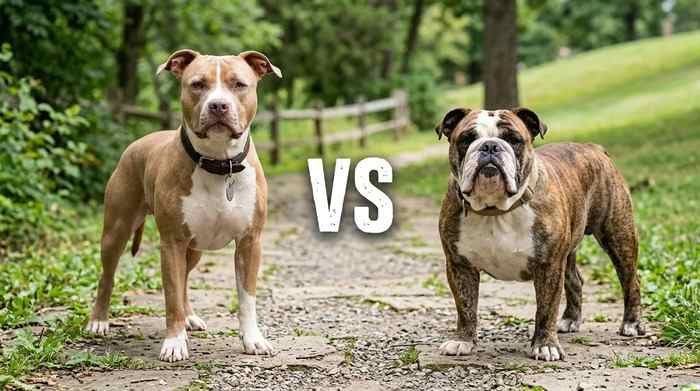
If the comparison is between an American Pit Bull Terrier-type dog and the English Bulldog, the Pitbull-type dog is generally more athletic, energetic and physically capable. But greater physical capability does not mean every Pitbull is aggressive or that Bulldogs cannot bite. Training, socialisation, genetics, health, previous experiences and responsible ownership all matter.
Pitbull vs Bulldog: Quick Comparison
| Feature | Pitbull-Type Dog | English Bulldog |
|---|---|---|
| General Build | Muscular and athletic | Heavy, compact and stocky |
| Energy Level | Usually High | Usually Low to Moderate |
| Physical Athleticism | High | Relatively Low |
| Exercise Requirement | High | Moderate, with heat limitations |
| Trainability | Generally High | Trainable but can be independent |
| Grooming | Relatively Low | Moderate, including skin-fold care |
| Heat Tolerance | Needs hot-weather precautions | Particularly vulnerable to heat |
| Potential Injury if Poorly Managed | Can be serious due to strength | Still capable of causing injury |
| Suitable for Beginners | Depends on experience and individual dog | Can be demanding for health-related reasons |
| Aggression Guaranteed by Breed? | No | No |
What Does “Pitbull” Actually Mean?
One problem with this comparison is that Pitbull is not always used to describe one precisely identified breed.
People may use the term for the American Pit Bull Terrier or for other muscular dogs with similar physical characteristics.
Dogs can also be incorrectly labelled as Pitbulls simply because they have:
- Broad heads
- Short coats
- Muscular bodies
- Strong jaws
This matters when discussing aggression statistics or behaviour because visual identification is not always reliable.
When buying or adopting a dog, find out as much as possible about its actual background instead of relying only on a seller’s label.
What Do We Mean by Bulldog?
“Bulldog” creates similar confusion.
The English Bulldog, often simply called Bulldog, is a compact dog with a broad head, short muzzle and heavy body.
The American Bulldog, however, is generally taller, more athletic and physically powerful.
Other breeds also contain “Bulldog” in their names.
Therefore, saying “Pitbulls are stronger than Bulldogs” without identifying the Bulldog breed can be misleading.
For the majority of this comparison, “Bulldog” refers to the familiar English Bulldog unless otherwise stated.
Which Dog Is Physically More Powerful?
Compared with an English Bulldog, a healthy adult Pitbull-type dog is generally more athletic.
Pitbull-type dogs commonly have:
- Strong muscular bodies
- Greater stamina
- Faster movement
- Higher exercise capacity
- Considerable physical strength
English Bulldogs are muscular too, but their compact build and short muzzle can limit endurance and exercise tolerance.
This distinction matters when discussing risk.
If a strong, athletic dog becomes involved in a serious incident, its physical ability can increase the potential severity of injury.
But capacity to cause harm and likelihood of aggression are two different things.
A large, powerful dog can be friendly and well managed, while a smaller dog can still display problematic aggression.
Is a Pitbull Naturally More Aggressive?
It is not scientifically sound to assume that every Pitbull-type dog is naturally dangerous to humans.
Canine behaviour develops through a combination of factors, including:
- Genetics
- Early socialisation
- Training
- Living conditions
- Previous experiences
- Fear and stress
- Health and pain
- Owner management
Dogs deliberately encouraged to behave aggressively or kept under poor conditions may present greater risks.
Early socialisation is particularly important.
A puppy should gradually learn to cope appropriately with normal experiences such as people, household sounds, veterinary handling and different environments.
The goal is not to force a dog to interact with everyone. It is to develop calm, manageable behaviour.
What About Bulldogs?
English Bulldogs are commonly kept as companion animals and are often described as relatively calm.
However, no dog should be considered incapable of biting.
A Bulldog may react defensively when it is:
- Frightened
- In pain
- Cornered
- Protecting a valued resource
- Poorly socialised
- Handled inappropriately
This is why children should never be encouraged to climb on, pull or disturb a dog simply because the breed has a friendly reputation.
Individual behaviour matters more than stereotypes.
Bite Force Numbers Can Be Misleading
Online Pitbull-vs-Bulldog comparisons frequently include precise bite-force numbers.
These figures should be treated cautiously.
A dog’s real-world bite depends on factors such as:
- Individual size
- Skull structure
- Motivation
- Position
- Measurement technique
More importantly, a bite-force number does not tell you whether a particular dog is likely to attack.
Safety is better assessed by looking at temperament, history, training and management rather than internet rankings of jaw strength.
There is also no special mechanism that allows a Pitbull’s jaw to “lock” in place. The popular idea of a unique locking jaw is a myth.
Why Pitbull Incidents Receive More Attention
Serious incidents involving muscular dogs often receive extensive media attention.
Part of the reason is potential consequence.
A powerful dog may cause more severe injury during a sustained bite than a much smaller dog.
That does not mean small dogs never bite. Their incidents may simply result in less serious physical injury and therefore receive less public attention.
This distinction is essential:
Bite frequency and bite severity are not the same measurement.
Public discussions frequently mix the two together.
Training Matters More With Powerful Dogs
All dogs benefit from training, but responsible control becomes especially important when a dog is strong enough to overpower its handler.
A Pitbull-type dog should reliably learn basic skills such as:
- Recall
- Sit
- Stay
- Loose-leash walking
- Leave it
- Calm behaviour around people
- Appropriate handling
Owners should use secure equipment suitable for the dog’s strength.
Training should focus on predictable, controlled behaviour rather than attempting to make the dog “tough.”
Encouraging aggression for status or entertainment creates unnecessary risks for the dog, owner and public.
Exercise Needs Are Very Different
Pitbull-type dogs are generally energetic and need regular physical activity and mental stimulation.
Activities may include:
- Daily walks
- Training
- Structured play
- Scent activities
- Interactive toys
A bored, under-stimulated dog can develop undesirable behaviours regardless of breed.
English Bulldogs usually require less intense exercise.
However, their short-muzzled anatomy creates another concern: heat and breathing difficulties.
In India’s hot climate, strenuous exercise during warm periods can be particularly dangerous for short-faced dogs.
Bulldogs require careful temperature management and should not be pushed into intense exercise simply to match another breed’s routine.
Which Is Better for Indian Weather?
Neither dog should be exposed to extreme Indian heat without appropriate precautions.
Pitbull-type dogs generally have short coats, but they can still overheat during strenuous exercise.
English Bulldogs require even greater caution because brachycephalic, or flat-faced, dogs may have difficulty cooling themselves efficiently.
During hot weather:
- Exercise during cooler hours.
- Provide constant access to clean water.
- Keep dogs in shaded, well-ventilated areas.
- Avoid hot pavement.
- Never leave a dog inside a parked vehicle.
- Stop exercise if the dog shows signs of overheating.
Potential Bulldog owners in particularly hot Indian cities should discuss heat and respiratory risks with a veterinarian.
Which Is Better Around Children?
Neither breed should automatically be labelled safe or unsafe around children.
A suitable family dog should have a stable temperament and appropriate socialisation.
Equally importantly, children need to learn correct behaviour around dogs.
They should never:
- Pull a dog’s ears or tail.
- Sit or climb on the dog.
- Disturb it while eating.
- Corner a frightened dog.
- Take toys or food directly from its mouth.
- Tease it to provoke a reaction.
Young children should be appropriately supervised around any dog, particularly large or powerful animals.
Legal Considerations in India
Owners considering Pitbull-type dogs should also pay attention to current local rules.
Dog-related regulations can involve central, state, municipal, housing-society and local administrative requirements. Rules concerning particular breeds have also been the subject of legal and regulatory developments in India.
Therefore, before purchasing or adopting any powerful breed, prospective owners should check the latest applicable rules in their city or state.
Responsible ownership may also involve registration, vaccination, leash control and other local requirements.
Pitbull vs Bulldog: Which Is More Dangerous?
If “dangerous” means which dog has greater athletic ability and potential to cause serious injury if badly managed, a Pitbull-type dog will generally present greater physical capability than an English Bulldog.
But that should not be translated into “all Pitbulls are dangerous.”
The real risk presented by an individual dog depends on a much broader combination of:
- Temperament
- Genetics
- Socialisation
- Training
- Health
- Owner responsibility
- Environment
- Previous behaviour
An English Bulldog is not automatically harmless, and a Pitbull-type dog is not automatically aggressive.
For prospective owners, the more useful question is not “Which dog is more dangerous?” but “Can I safely and responsibly manage this individual dog’s needs, strength and behaviour for its entire life?”
FAQs
1. Is a Pitbull more dangerous than an English Bulldog?
A. A Pitbull-type dog is generally more athletic and physically capable than an English Bulldog, so a serious incident could potentially cause substantial injury. However, breed name alone cannot determine whether an individual dog will behave aggressively.
2. Do Pitbulls have locking jaws?
A. No. The popular claim that Pitbulls possess a special anatomical jaw-locking mechanism is a myth. They are strong dogs, but their jaws do not contain a unique biological locking system.
3. Which is easier for a first-time dog owner: Pitbull or Bulldog?
A. An English Bulldog may require less vigorous exercise, but its breathing, skin and heat-related health requirements can be demanding. A powerful Pitbull-type dog requires consistent training and responsible physical management. First-time owners should evaluate the individual dog and their own experience rather than choosing based solely on breed appearance.
4. Can Pitbulls and Bulldogs live in Indian apartments?
A. Potentially, but their needs are different. A Pitbull-type dog requires substantial exercise and mental stimulation even in an apartment. An English Bulldog may need less activity but requires careful heat management and appropriate veterinary attention. Housing-society and local legal requirements should also be checked before adoption or purchase.