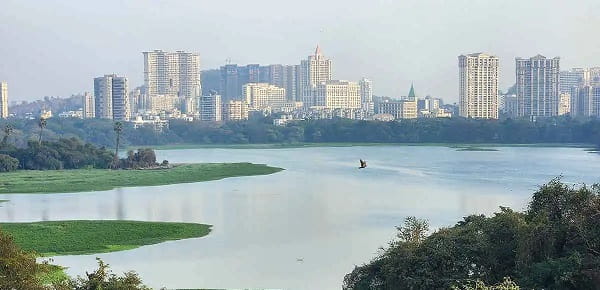
Mumbai is a city of extraordinary contrasts — and perhaps none is more striking than the contrast between its relentless urban energy and the quiet, green serenity of Powai Lake. Tucked within the Powai Valley in the city’s northern suburbs, surrounded by the leafy campuses of IIT Bombay and the manicured boulevards of the Hiranandani Township, Powai Lake is the closest thing Mumbai has to a genuine natural sanctuary within its own city limits. The lake covers approximately 2.1 square kilometres and was created in 1891 by the British colonial administration through the construction of two dams on the Mithi River — originally designed as a water reservoir for Mumbai’s growing population. While the water’s quality eventually made it unsuitable for drinking, the lake has since become one of Mumbai’s most cherished urban green spaces — maintained by the Maharashtra State Angling Association (MSAA) since 1936, home to the endangered Indian Mahseer fish, visited by falcons, kingfishers, herons, spot-billed ducks, and migratory birds in winter, and famously inhabited by crocodiles that occasionally sun themselves on the lake’s rocky banks. In a city that relentlessly and remorselessly devours its own green spaces, Powai Lake stands as a genuinely precious urban oasis. Here is everything you need to know.
Quick Overview — Powai Lake Mumbai
| Detail | Information |
| Location | Powai Valley, Powai, Mumbai, Maharashtra – 400076 |
| Type | Artificial Reservoir (Built 1891 by British Administration) |
| Lake Area | ~2.1 Square Kilometres (6.6 km circumference) |
| Lake Depth | 3 to 12 metres |
| Timings | Open 24 Hours |
| Entry Fee | No entry fee |
| Created By | British Administration — 1891 (Damming Mithi River) |
| Maintained By | Maharashtra State Angling Association (MSAA) since 1936 |
| Nearest Railway Station | Kanjurmarg — Central Line (~3 km) |
| Nearest Metro Station | Mumbai Metro Line 6 — Vikhroli to Kanjurmarg |
| Nearest Airport | Chhatrapati Shivaji Maharaj International Airport — ~10-12 km |
| Best Time to Visit | October to March |
Location of Powai Lake
Powai Lake is situated in the Powai Valley in Mumbai’s northern suburbs — bordered by IIT Bombay’s vast campus on one shore, Hiranandani Gardens on another, and the Renaissance Hotel on a third side.
Powai Lake is located in the Powai neighbourhood of Andheri East, Mumbai, Maharashtra — PIN 400076, in the northern suburban corridor of the city. The lake’s position within the Powai Valley gives it a naturally elevated and enclosed character — the surrounding hillside vegetation and the absence of large commercial developments immediately adjacent to the shoreline create a surprising degree of visual separation from the urban density just beyond. The lake is bordered by several of Mumbai’s most prestigious and well-known institutions and addresses — the Indian Institute of Technology Bombay (IIT Bombay) whose vast 550-acre campus occupies the eastern and northeastern shoreline, the Hiranandani Gardens Township — one of Mumbai’s most upscale residential developments — which faces the lake from the western bank, and the JW Marriott / Renaissance Hotel complex on the northwestern shore. The National Institute of Industrial Engineering (NITIE) is also located in close proximity on the lake’s northern bank.
The lake sits downstream of Vihar Lake along the Mithi River and is connected to Mumbai’s historical water infrastructure through the dams constructed during British administration. The concrete dam on the lake’s southern side has an adjoining promenade that offers panoramic views across the water. The lake’s fame also rests on its resident mugger crocodile population — a genuinely wild urban wildlife presence that visitors are warned to respect by maintaining a safe distance from the water’s edge.
Directions to Powai Lake
Powai Lake is accessible by train, metro, road, and bus from all parts of Mumbai — its northern suburban location is well-served by the Central Line and Mumbai Metro Line 6.
From Kanjurmarg Railway Station (Central Line) — approximately 3 km from Powai Lake, the nearest suburban rail access point. Auto-rickshaws, taxis, and app-based cabs are available outside the station. Journey time to the lake approximately 10-15 minutes. From Vikhroli Railway Station (Central Line) — also accessible by auto-rickshaw or cab, approximately 4-5 km from the lake. Mumbai Metro Line 6 (Vikhroli to Kanjurmarg corridor) provides rapid transit connectivity to the Powai area — making it increasingly accessible for commuters from Western and Central Mumbai. From Chhatrapati Shivaji Maharaj International Airport — approximately 10-12 km by road via the Eastern Express Highway and Saki Vihar Road, accessible in approximately 25-30 minutes. From Bandra-Kurla Complex (BKC) — approximately 12-15 km by road via the Eastern Freeway approach, accessible in 25-35 minutes depending on traffic. BEST buses serving the Powai and LBS Marg corridors stop near the lake’s main entrance. The Powai Garden on the lake’s western shoreline near the Hiranandani Boulevard is the most commonly used entry area for visitors — well-marked from the main Powai road.
Timings and Activities
Powai Lake is accessible at all hours with no entry fee — its character as a quiet, contemplative urban escape makes early mornings and evenings the most rewarding times for nature observation.
Powai Lake is open 24 hours a day with no entry fee — a generosity that reflects its status as a genuine public urban green space in one of the world’s most expensive cities. The most rewarding visiting times are early morning from 6:00 AM to 9:00 AM — when birdlife is most active, the light is best for photography, and the lake carries a particular stillness before Mumbai’s urban noise builds. Evenings from 5:00 PM to 7:30 PM are the most popular among local residents — the sunset colours over the Hiranandani skyline reflected in the lake’s surface create a distinctively beautiful Mumbai urban landscape.
Birdwatching is Powai Lake’s most rewarding activity — resident species include kingfishers, spot-billed ducks, herons, egrets, bulbuls, and spotted doves. Winter months bring migratory birds including additional waterfowl species that significantly expand the bird count. Photography at Powai Lake offers a genuinely unique compositional element — the combination of modern high-rise architecture reflected in natural water with birds in the foreground creates images that feel distinctively Mumbai. Fishing has been regulated by the MSAA since 1936 with a specific focus on conserving the endangered Indian Mahseer — casual fishing is not permitted without association permission. Walking around the lake’s perimeter is a popular morning exercise for IIT Bombay students and Hiranandani residents. The Powai Garden adjacent to the western shore offers maintained walking paths and seating.
Important Safety Note — Powai Lake’s resident mugger crocodile population is a genuine and well-documented presence. Visitors must maintain a safe distance from the water’s edge at all times and follow all signage regarding the crocodiles. Swimming in the lake is strictly inadvisable.
Nearby Places
Powai Lake’s northern Mumbai location places it within reach of the city’s most prestigious educational campuses, upscale dining, and several important heritage and natural destinations.
IIT Bombay Campus — One of India’s premier technical universities, whose beautiful 550-acre campus borders the lake directly and includes its own gardens, heritage buildings, and an active cultural and academic environment. Visitors can access the campus with prior permission. Hiranandani Gardens — Mumbai’s most upscale planned township, featuring European-style architecture, premium restaurants, cafes, Galleria Mall, and beautifully maintained streets directly adjacent to the lake’s western shore. Sanjay Gandhi National Park (Borivali) — Mumbai’s extraordinary forested national park — home to leopards, deer, crocodiles, and over 270 bird species — approximately 15-18 km north of Powai via the Western Express Highway. Powai Plaza and Galleria Mall — Premium shopping and dining within walking distance of the lake in the Hiranandani Township. Jogeshwari Caves — Ancient Buddhist rock-cut caves approximately 10-12 km from Powai, among Mumbai’s lesser-known historical heritage sites. Vihar Lake — The larger upstream companion reservoir to Powai Lake, accessible in the northern suburbs for additional lakeside scenery.
FAQs — Powai Lake Mumbai
Q1. What are the timings of Powai Lake Mumbai?
A: Powai Lake is open 24 hours a day with no entry fee — early morning (6:00-9:00 AM) and evenings (5:00-7:30 PM) are the most rewarding visiting times.
Q2. Is there an entry fee for Powai Lake Mumbai?
A: No — Powai Lake is completely free to visit at any time. It is a public space maintained by the Maharashtra State Angling Association (MSAA).
Q3. Are there crocodiles in Powai Lake?
A: Yes — Powai Lake has a resident population of mugger crocodiles. Visitors must maintain a safe distance from the water’s edge and follow all safety signage strictly.
Q4. When was Powai Lake built and by whom?
A: Powai Lake was created in 1891 by the British colonial administration through the damming of the Mithi River — originally intended as a water reservoir for Mumbai.
Q5. What is the best time to visit Powai Lake Mumbai?
A: October to March is ideal — cooler weather makes outdoor visits comfortable, and winter months bring migratory birds that significantly enrich the birdwatching experience. Early mornings are best for both birds and photography.